Price Prediction: Nvidia Stock Could Be Worth This Much by 2030
Nvidia just posted the largest quarter in semiconductor history, yet the stock trades like Wall Street is only half-convinced. A credible case exists for 160% gains by 2030, but it hinges on three specific things going right.

This post may contain links from our sponsors and affiliates, and Flywheel Publishing may receive compensation for actions taken through them.

NVIDIA (NASDAQ:NVDA | NVDA Price Prediction) just posted the largest quarter in semiconductor history, and the stock still trades like the market is only half-convinced. Data Center revenue hit $89.02 billion, up 117% year over year, and CEO Jensen Huang told investors “AI is now doing productive and useful work” that generates profitable tokens.
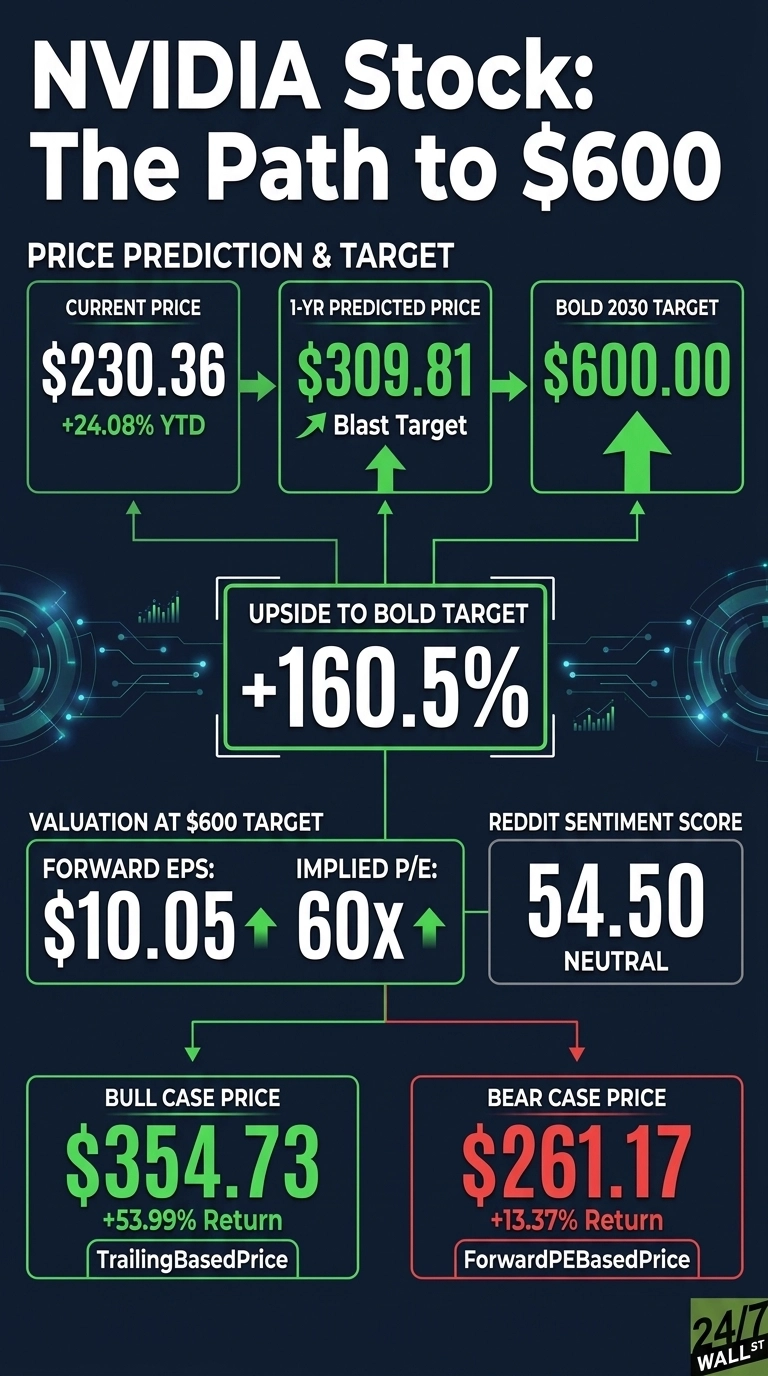
Shares are up 24.08% year to date, respectable but hardly euphoric. So here is the question I want to answer: can NVIDIA reach $600 per share by 2030?

What Is Holding NVIDIA Back Right Now
NVIDIA is performing well. Shares are up 6.24% over the past week and 5.43% over the past month. The issue is that the stock has been chopping in a range for most of 2026 while the fundamentals accelerated past almost every reasonable model.
Two overhangs explain it. First, China Data Center compute revenue is guided at zero for Q3, and management stated bluntly that “there is no China data center compute revenue in our forward outlook.”
Second, memory pricing has spiked, and Huang warned the increases “have exceeded our prior expectations and are headed even higher into next year.”
With a beta of 2.217, NVDA amplifies every macro wobble. That is why a company growing revenue at triple digits still trades at a forward multiple in the low 20s.
Wall Street Sees 42% Upside. Our Model Sees Something Bigger
The consensus is loud. Of the 60 analysts covering NVDA, 9 rate it strong buy, 48 buy, 2 hold, and 1 sell, with an analyst target price of $327.13. That implies roughly 42% upside from here.
Our 24/7 Wall St. model is more constructive still, targeting a base-case price of $309.81 in a year with a confidence score of 0.9 and a bull case of $354.73.
Here is where I push back. Consensus is anchored to fiscal 2027. It is not fully pricing the fiscal 2028 EPS estimate, which has jumped from $12.63 to $15.46 in just 90 days on 39 upward revisions. Analysts are catching up, not leading.

Path to $600 Per Share by 2030
Reaching $600 from today’s price of $230.36 would require a gain of 160.5%. With forward EPS of $10.05, a price of $600 implies a forward P/E of 60x on today’s earnings power. Our base case of $309.81 already implies 33x, meaning the bold target requires 27x of additional multiple expansion on current forward EPS.
Here is the compression story that makes it work: if fiscal 2028 EPS lands at consensus $15.46 and the company grows revenue approximately 70% in fiscal 2028 as guided, EPS by fiscal 2031 could clear $25. At that level, $600 is a 24x multiple.
Catalysts to get there are already in motion: Vera Rubin generating $40 billion per gigawatt versus Blackwell’s $25 billion, top-five hyperscaler capex projected at $1.3 trillion in 2027, and cloud industry backlog now above $2 trillion.
Not all of that trillion-dollar buildout accrues to NVIDIA; the power, cooling, and networking suppliers behind the data centers ride the same wave, and we profiled seven of them in a free report you can grab here. The primary risk is that supply constraints or a China escalation cap unit growth before EPS can catch the multiple.
Where NVIDIA Trades Today vs Its Earnings Power
At $231.13, NVDA trades at roughly 23x forward earnings. That looks reasonable for a business with 75% non-GAAP gross margins and 126% net income growth, it is a discount to almost any historical AI-cycle comparison.
Shares sit near the 52-week high of $236.26, well off the low of $164.08. Long-term context matters. NVDA is up 14,808% over the past decade. Today’s multiple is the cheapest it has been during any major NVIDIA product cycle since Hopper.
Is $600 Realistic? My Verdict
Reaching $600 by 2030 requires a 160.5% gain and, more importantly, EPS growth doing most of the heavy lifting so the forward P/E can actually compress into the low 20s at that price. My take: it is a stretch, but a credible one.
Three things need to go right. Vera Rubin has to become “the fastest product ramp in NVIDIA’s history” as management promises, hyperscaler capex has to sustain through the decade, and non-hyperscaler ACIE revenue has to keep compounding at triple digits. A hard China decoupling or a hyperscaler capex reset would derail it. Returns at this level shouldn’t be expected every year, but we’ve outlined the blueprint for how NVIDIA could reach $600 in 2030.
Contact [email protected] for any questions or corrections.
Vandita Jadeja is a financial publisher with over a decade of experience writing about financial topics, including investment, savings, retirement, insurance and banking. Vandita is a Chartered Accountant who loves to debunk financial concepts for readers.
Her work has appeared on sites that include The Motley Fool, InvestorPlace, and Benzinga. She covers investing and focuses on stock picks and price prediction for 24/7 Wall St.
When not looking for the next stock investment opportunity, she can be found traveling, reading, chasing sunsets and enjoying her iced latte.